Walk into any well-run food warehouse and you'll notice something interesting: the product barely stops moving. Every stage exists for a reason — safety, traceability, or quality — and skipping even one creates risk downstream. Here's how a typical cold-chain food warehouse takes a truck-load of raw produce or meat and turns it into a dispatch-ready, quality-certified product.
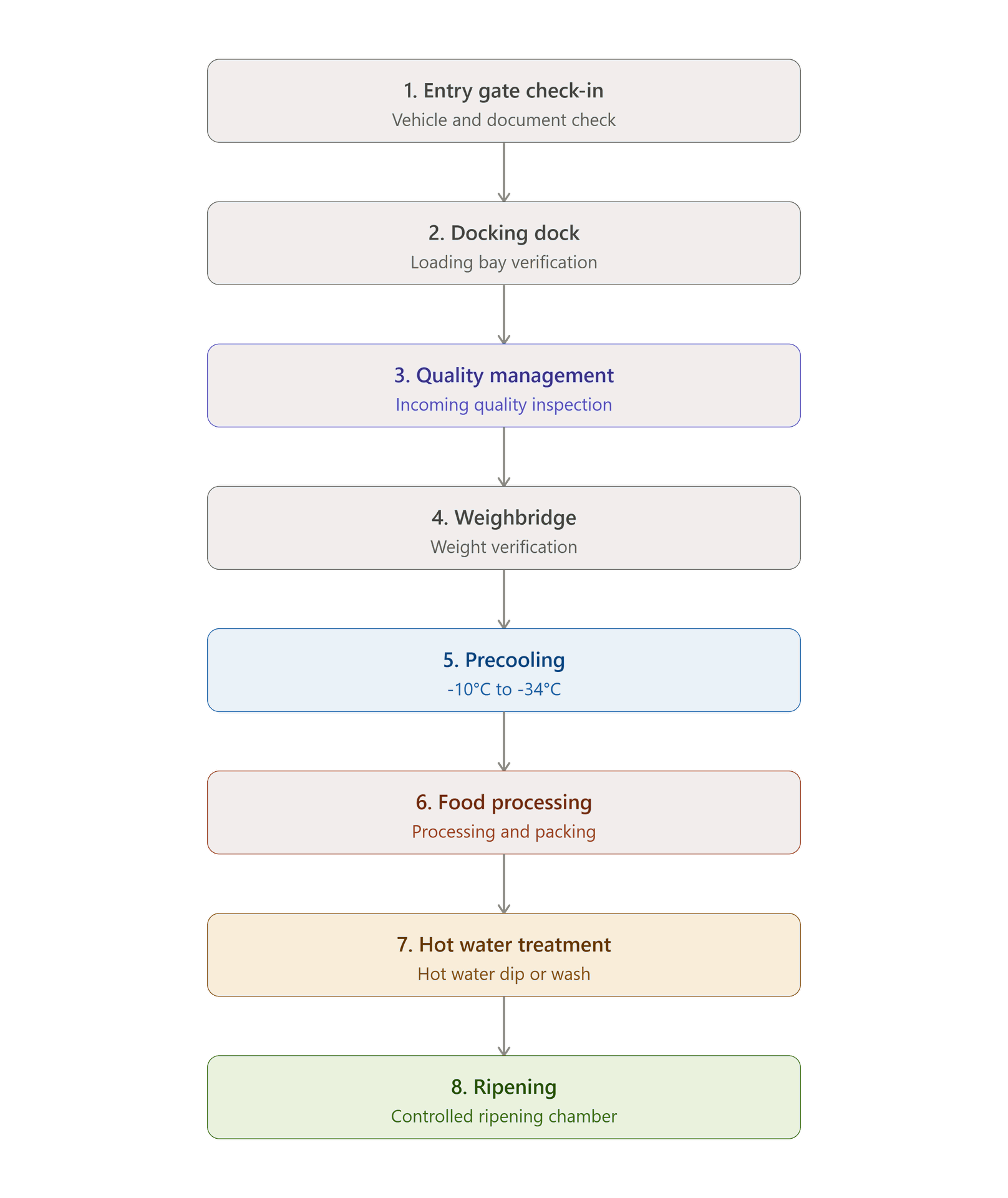
1. Entry gate check-in
The journey starts at the gate. Security and admin staff verify the vehicle, the driver's ID, and the delivery paperwork — purchase order, invoice, and any transport permits. This is also where a digital gate pass is usually generated, feeding into the warehouse management system (WMS) so the rest of the facility knows a shipment has arrived.
2. Docking dock
Once cleared, the vehicle is directed to a docking bay. Here, staff check the trailer's seal integrity, confirm the load matches the manifest, and inspect for visible damage or temperature abuse during transit. Only after this "after checking" step is the vehicle allowed to unload.
3. Quality management
Before a single crate touches the storage floor, the quality team steps in. This is where samples are pulled for visual inspection, moisture or ripeness checks, pest screening, and documentation review (certificates of analysis, FSSAI/HACCP compliance, batch numbers). A rejected batch is flagged and quarantined right here, before it can contaminate good stock.
4. Weighbridge
Next, the entire consignment crosses the weighbridge. This isn't just for billing — weight discrepancies between the invoice and actual delivered weight are often the first sign of pilferage, spoilage, or a packing error. The recorded weight becomes the reference figure for every later reconciliation.
5. Precooling (-10°C to -34°C)
This is the stage that protects everything else. Fresh produce or meat carries "field heat" that needs to be pulled out fast, or spoilage sets in within hours. Precooling tunnels or blast freezers bring the product down to anywhere between -10°C and -34°C depending on the item — deep-frozen seafood needs the colder end, while pre-chilled vegetables sit closer to -10°C. Getting this step right is what actually defines shelf life.
6. Food processing
With temperature under control, the product moves into processing — sorting, cutting, deboning, grading, or packing, depending on the product line. This is typically the most labor- and equipment-intensive stage, and it's where ERP-driven batch tracking earns its keep, since every processed lot needs to trace back to its original delivery.
7. Hot water treatment
Somewhat counterintuitively, many food lines then pass through a hot water stage — used for blanching, pathogen reduction, wax removal on produce, or pasteurization-style treatment depending on the product. It's a short, tightly controlled exposure, immediately followed by cooling again to avoid overcooking or bacterial regrowth.
8. Ripening
For fruits like bananas, mangoes, or tomatoes, the final stage is a controlled ripening chamber — using ethylene gas, temperature, and humidity control to bring the product to the exact ripeness stage the buyer wants, timed against the dispatch schedule.
Why this matters for warehouse software
Each of these eight stages generates data: gate timestamps, quality rejection reasons, weighbridge slips, cold-room temperature logs, batch and lot numbers, treatment timings. A warehouse running on spreadsheets loses this data at every handoff. An ERP-integrated system — like an Odoo-based warehouse module — captures each stage as a linked record, so a single batch number can be traced all the way from the entry gate to the ripening chamber to the delivery truck. That traceability isn't just good practice anymore; for food businesses, it's increasingly a regulatory requirement.