
Docker and Kubernetes Together: The Modern Way to Scale Your Servers
If you've spent any time deploying applications, you've probably run into the classic problem: it works perfectly on your machine, but breaks the moment it hits production, or works fine until traffic spikes and your single server can't keep up. Docker and Kubernetes were built to solve exactly this problem, and together they form one of the most powerful combinations in modern DevOps.
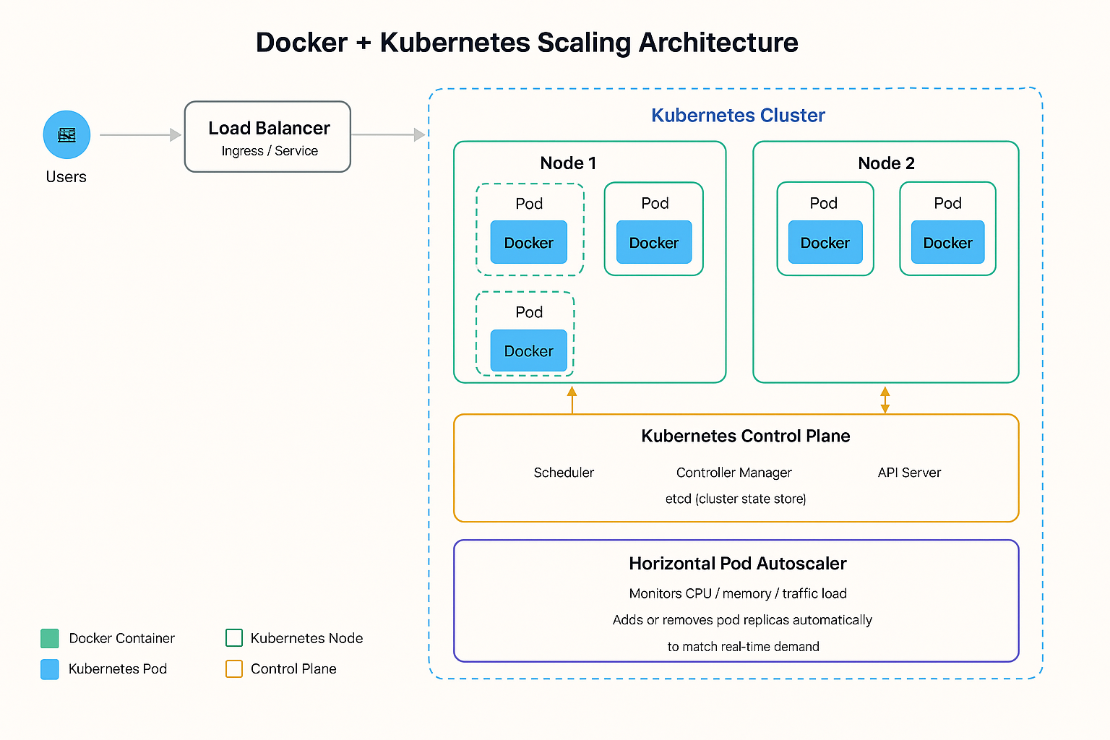
What Docker Does
- Packages your application along with its code, runtime, libraries, and dependencies into a single portable unit called a container.
- Ensures the app runs exactly the same way on your laptop, a teammate's machine, or a production server.
- Eliminates the classic "it worked on my machine" problem by removing environment mismatches.
- Allows you to build a container once and reuse it across development, staging, and production.
- Makes app startup fast since containers share the host OS kernel instead of running a full virtual machine.
What Kubernetes Does
- Acts as a container orchestration platform that manages many containers running across multiple servers.
- Automatically starts, stops, and restarts containers based on a "desired state" you define (e.g., "always keep 3 copies of this service running").
- Distributes containers intelligently across available servers (called nodes) based on resource usage.
- Detects failed containers or crashed nodes and automatically reschedules workloads to healthy machines.
- Manages networking between services, so containers can discover and talk to each other reliably.
- Handles rolling updates, replacing old containers with new versions gradually, without downtime.
Why Use Docker and Kubernetes Together
- Docker answers: "How do I package and run this application consistently?"
- Kubernetes answers: "How do I manage hundreds of these containers across many servers reliably?"
- Docker provides the standardized container format that Kubernetes needs to manage workloads at scale.
- Without Docker, Kubernetes has no consistent unit to orchestrate.
- Without Kubernetes, Docker containers must be managed manually, which breaks down quickly as systems grow.
- This pairing is especially valuable for ERP systems, SaaS platforms, and multi-tenant applications where uptime and consistency are critical — for example, containerizing individual modules of an Odoo deployment while Kubernetes handles load balancing and failover across the cluster.
Key Benefits of Scaling with Docker + Kubernetes
- Automatic horizontal scaling — Kubernetes detects increased load and spins up additional container instances on demand, then scales back down when traffic drops.
- Cost efficiency — you only run the resources you actually need, instead of over-provisioning servers for peak traffic that may rarely happen.
- Zero-downtime deployments — rolling updates replace containers gradually, so users never experience an outage during releases.
- Self-healing infrastructure — crashed containers or failed nodes are automatically detected and replaced without manual intervention.
- Consistent environments — the same container image runs identically everywhere, removing configuration drift between dev, staging, and production.
- Better resource utilization — workloads are packed efficiently across nodes instead of each service needing its own dedicated server.
- Faster recovery from traffic spikes — new instances can be provisioned in seconds rather than the hours it would take to manually configure a new server.
Wrapping Up
- Docker and Kubernetes solve two connected problems: packaging applications consistently, and managing them reliably at scale.
- Together, they shift infrastructure management from manual, reactive server administration to automated, demand-driven scaling.
- For any growing application, especially one serving multiple clients or facing unpredictable traffic, this combination has become the standard way modern, scalable software is built and run.