
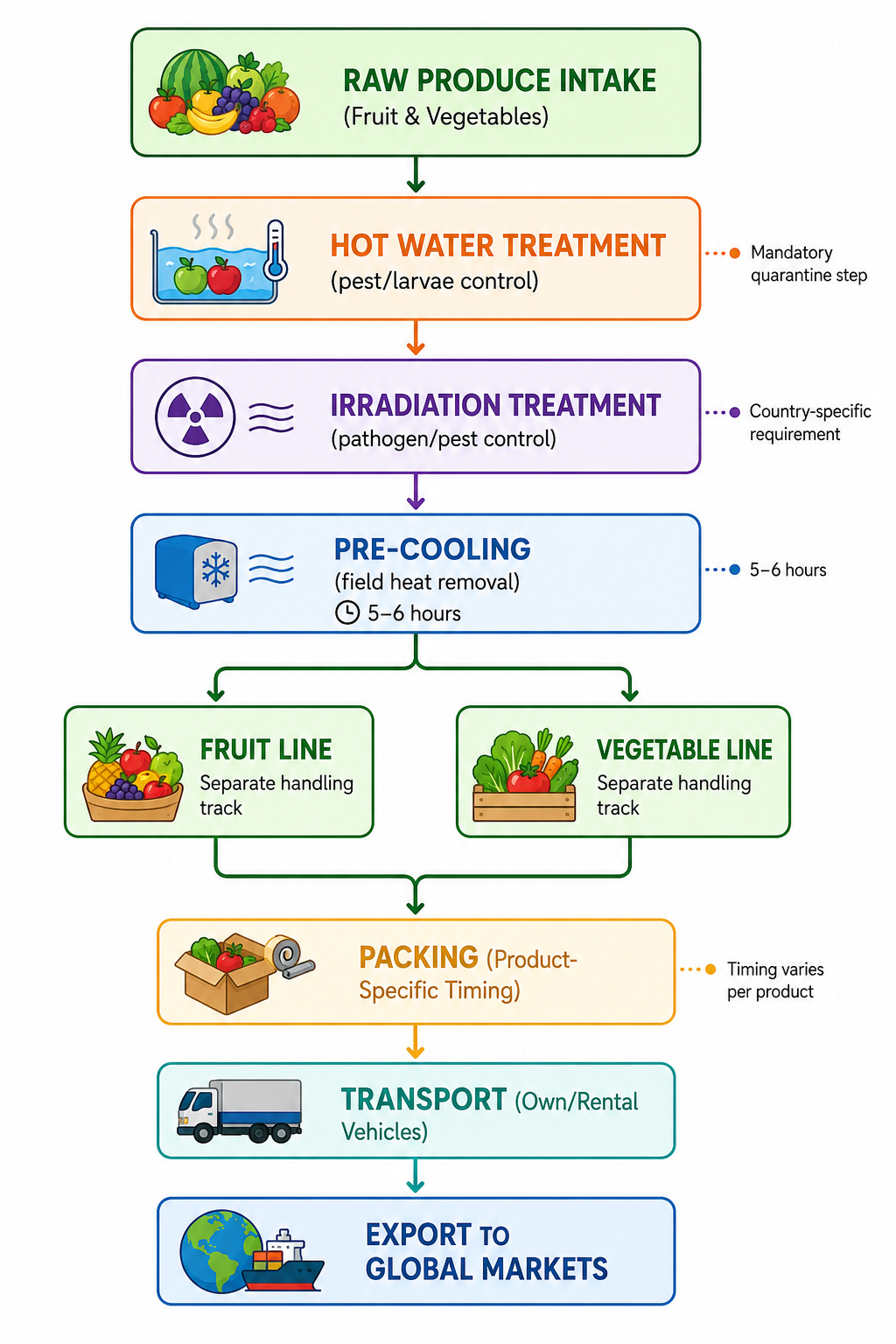
Every day, fruits and vegetables leave our facility bound for markets across the world. Behind every crate that reaches a store shelf overseas is a carefully controlled process — one built around food safety regulations, international quarantine requirements, and strict timing. This blog walks you through exactly how our plant takes raw, harvested produce and turns it into export-ready cargo, step by step.
We handle both fruit and vegetable exports, and every product moves through a defined treatment and packing pipeline before it ever leaves our gates.
Step 1: Hot Water Treatment (Mandatory)
Before anything else happens, produce goes through hot water treatment. This isn't optional — it's a mandatory quarantine step required by most importing countries to eliminate pests, larvae, and fruit flies that could otherwise be rejected at customs or cause biosecurity issues in the destination country.
- Produce is dipped or immersed in water held at a precisely controlled temperature for a set duration.
- Temperature and time vary by product, since different fruits and vegetables have different tolerances.
- This step is a compliance requirement for export — without it, shipments simply cannot be cleared for many destinations.
Why it matters: Skipping or mishandling this step is the single biggest reason export shipments get rejected at the border. Getting it right protects both compliance and product quality.
Step 2: Irradiation Treatment
After hot water treatment, select produce moves into irradiation treatment. This is an additional layer of pest and pathogen control, often required by countries with stricter phytosanitary standards.
- Irradiation neutralizes pests and slows spoilage without affecting the produce's taste or nutritional value.
- It's used as either a standalone requirement or in combination with hot water treatment, depending on the destination country's rules.
- This step further extends shelf life during long international transit.
Why it matters: Some countries accept hot water treatment alone; others require irradiation as well. Knowing which markets need which treatment is core to smooth, rejection-free exports.
Step 3: Pre-Cooling (5–6 Hours)
Once treated, produce isn't packed immediately — it goes through pre-cooling, typically lasting 5 to 6 hours.
- Pre-cooling rapidly removes field heat from the produce right after treatment.
- This slows down the ripening and decay process before the product enters cold chain transport.
- Proper pre-cooling is what allows produce to survive long sea or air freight without significant quality loss.
Why it matters: Produce that isn't properly pre-cooled degrades faster in transit — even if everything else was done correctly. This step protects the investment made in every earlier stage.
Step 4: Vegetable Export Line
Alongside fruit, we run a dedicated vegetable export line. Vegetables often have different handling needs — different temperature sensitivities, different treatment requirements, and different packing formats — so they're processed on their own track rather than mixed with fruit processing.
This ensures:
- No cross-contamination between product types
- Treatment steps are tailored to each vegetable's specific tolerance
- Packing formats match what each destination market expects
Step 5: Transportation — Own or Rental Vehicles
Once produce is treated and pre-cooled, it needs to move — either within the facility or to the next stage of the supply chain. We offer flexibility here:
- Clients or partners can use their own vehicles, or
- We provide rental vehicle options for transport
This flexibility helps exporters manage costs and logistics according to their own supply chain setup, without being locked into a single transport model.
Step 6: Packing (Product-Specific Timing)
The final stage before dispatch is packing — and timing here is not one-size-fits-all.
- Every product has its own packing time window, determined by how it responds after pre-cooling and treatment.
- Packing too early or too late can affect shelf life or lead to condensation/moisture issues inside the packaging.
- Our team follows product-specific timing charts to ensure each item is packed at exactly the right point in the process.
Why it matters: Correct packing timing is what preserves everything achieved in the earlier treatment and cooling stages, right up until the product reaches its final destination.
Why This Process Matters for Exporters
Put together, this pipeline — Hot Water Treatment → Irradiation → Pre-Cooling → Vegetable Line Handling → Transport → Product-Specific Packing — is what allows us to export to countries around the world with confidence. Each step exists to solve a specific problem: pest compliance, pathogen control, heat removal, logistics flexibility, and shelf-life preservation.
For exporters, this means fewer rejected shipments, longer shelf life on arrival, and consistent compliance with international phytosanitary standards.
Closing Thought
Exporting fresh produce isn't just about growing good fruit and vegetables — it's about what happens after harvest. Our process is built to protect quality at every single stage, so that what leaves our plant arrives at its destination fresh, compliant, and ready for the shelf.