
Open Notebook: The AI-Powered Research Tool That Puts Privacy First
In a world where every note you take, every article you bookmark, and every idea you jot down gets quietly harvested by the platforms you use, one open-source project is pushing back. Open Notebook is an AI-powered knowledge and research platform built on a single, uncompromising premise: your context is yours.
This isn't another note-taking app with a chatbot bolted on. It's a rethinking of how people learn, research, and build knowledge — with AI as a genuine thinking partner rather than a data extraction engine.
What Is Open Notebook?
Open Notebook describes itself as "the cognitive partner you always wanted and could never explain why." It combines the power of AI with privacy controls designed for researchers, students, and professionals who want to enhance their learning while maintaining complete control over their workflows, models, and how their data gets used. open-notebook
The project is fully open-source (MIT licensed), self-hosted, and built around the idea that the best AI assistant is one that works for you — not for a company that profits from knowing your thoughts.
It targets a specific kind of user: someone constantly seeking knowledge who wants to go beyond surface-level understanding, who believes their learning can improve with a tailor-made AI partner, and who has hundreds of links they'd love to read but never find the time for. open-notebook
How It Works: The Four-Step Learning Journey
The core workflow is straightforward. You create notebooks for topics you're learning, add your study materials, use AI to analyze them, ask questions, and create notes. Your AI partner helps you think better while keeping your data private. open-notebook
Here's a visual of that flow:
Here is the full blog post with two diagrams:
Open Notebook: The AI-Powered Research Tool That Puts Privacy First
In a world where every note you take, every link you save, and every idea you develop gets quietly processed by the platforms you trust, one open-source project is pushing back hard. Open Notebook is an AI-powered knowledge and research platform built on a single, uncompromising premise: your context is yours, and yours alone.
This isn't another note-taking app with a chatbot bolted on. It's a rethinking of how people learn, research, and build knowledge — with AI as a genuine thinking partner rather than a data extraction engine.
What Is Open Notebook?
Open Notebook describes itself as "the cognitive partner you always wanted and could never explain why." It combines the power of AI with privacy controls designed for researchers, students, and professionals who want to enhance their learning while maintaining complete control over their workflows, models, and how their data gets used and exposed. open-notebook
The project is fully open-source under the MIT license, self-hosted, and built around a philosophy that the best AI assistant is one that works for you — not for a tech company that monetizes everything you think about.
It targets a specific kind of user: someone constantly seeking knowledge who wants to go beyond surface-level understanding, who believes their learning can improve with a tailor-made AI partner, and who has hundreds of links they'd love to read but never finds the time for. If you've ever had a browser full of "read later" tabs that you never actually read later, Open Notebook was designed with you in mind. open-notebook
The Four-Step Learning Journey
The core workflow is straightforward: create notebooks for topics you're learning, add your study materials, use AI to analyze them, ask questions, and create notes. Your AI partner helps you think better while keeping your data private. open-notebook
Here is how that process flows, step by step:
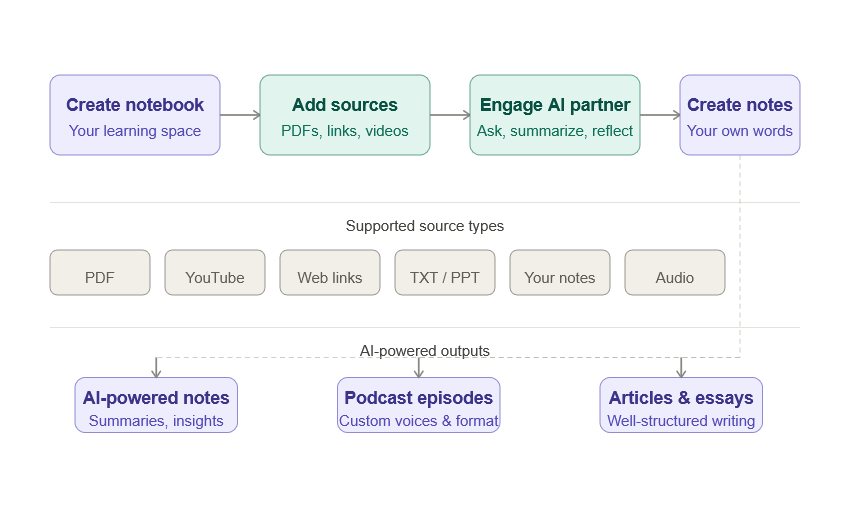
Step 1 — Create Your Knowledge Hub. Within the tool, you can create an unlimited number of notebooks. Think of them like projects or learning spaces — one for "how to build a wooden chair," another for "transformers and their role in AI evolution," or whatever sparks your curiosity. open-notebook
Step 2 — Gather Your Sources. Add sources of knowledge — videos, PDFs, websites, or your own notes from another tool — to the notebook's source area. At this point you can use several different transformations to extract valuable data like summaries, key points, and reflections, all with the assistance of your preferred LLM model. open-notebook
Step 3 — Engage With Your AI Partner. Now comes the magical part. Your AI partner helps you answer questions about your collected knowledge, test your understanding, provide different viewpoints, stimulate clearer thinking, and generate new insights. open-notebook
Step 4 — Create and Connect. At any point in this process, you can create notes either fully manually, by leveraging what the AI wrote, or by combining both. Every time you ask a question, you get to pick which of your sources and notes gets exposed to the AI model so you control which information will be used in the answer. open-notebook
Key Features
Open Notebook ships with a thoughtfully curated set of tools that cover the entire research lifecycle.
AI-Powered Notes let you leverage AI to summarize content, surface key points, generate reflections, and produce structured insights — while always giving you full control over which sources the AI can actually see. Privacy is not an afterthought; it's baked into every interaction.
The Podcast Generator is one of the most distinctive features. It transforms your notes into engaging podcasts with customizable voices, speakers, and episodes. Whether you want to review your research during a commute or share your findings with someone in an audio-first format, this turns static notes into living content. open-notebook
Content Integration is broad and practical. Open Notebook supports links, PDFs, TXT, PPT, YouTube, and more. Whatever format your knowledge comes in, you can bring it into your workspace without reformatting or converting. open-notebook
Search & Ask combines full-text search with vector search so you can surface relevant material across all your notebooks — not just by keyword, but by semantic meaning. You can ask a question and get an answer drawn from the specific sources you designate.
Transformations are automated processing steps that enrich your source material — generating summaries, extracting key points, identifying themes, and building bridges between ideas. They save the tedious skimming work so you can focus on the actual thinking.
Model Provider Support means you are not locked into any single AI vendor. You can bring your own API keys and choose which provider and model to use for each task, giving you full control over cost, capability, and data handling.
The Vision: AI as a Cognitive Partner, Not a Surveillance Tool
What separates Open Notebook from the wave of AI productivity tools is its philosophical clarity about what AI should be.
Open Notebook's team envisions a future where knowledge management is both powerful and private. Their aim is to revolutionize the way individuals learn, research, and engage with their own knowledge — creating an ecosystem where artificial intelligence enhances human capability without exploiting personal context. open-notebook
The project is inspired by principles of lifelong learning, the Zettelkasten method, and the mindset of ultralearning. At the core of the vision is a Zettelkasten-inspired approach: capturing ideas in atomic, concise notes and interlinking them to form a network of insights that grows with you. Your knowledge should evolve into a web of interconnected ideas — a personal knowledge graph — that helps you uncover patterns, generate new insights, and explore ideas in ways that traditional notes cannot offer. open-notebook
The team sees AI not as a replacement for human effort, but as a powerful cognitive partner that can handle processing and research — sifting through vast amounts of information to surface what is most important — while also questioning your thinking, constantly challenging assumptions, and helping you see different perspectives. open-notebook
Feature & Architecture Overview
Here is a structural view of how Open Notebook's components relate to each other:
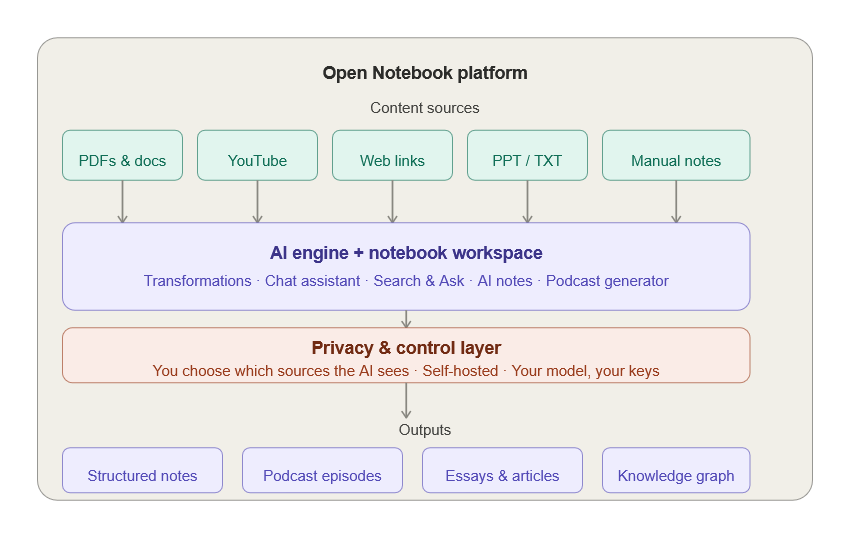
The architecture makes one thing immediately clear: the privacy and control layer is not optional middleware — it sits between the AI engine and everything that leaves the system. Every output you generate passes through the explicit choices you made about what the AI was allowed to see.
The Roadmap Ahead
Open Notebook is in active development with ambitious near-term goals.
In the short term, the team is focused on enhanced content processing capabilities, improved research and citation tools similar to Perplexity or Searxng, and integration with popular bookmark managers like Readwise and Pocket. open-notebook
In the medium term, they plan to ship an advanced AI learning assistant to better support each user's journey, a custom plugin marketplace, automated knowledge graph generation to visualize how ideas interconnect, and native mobile app support. open-notebook
The long-term vision is bold: custom teaching models tailored to specific interests, research workflow automation to remove repetitive tasks, and a truly personalized learning and thinking partner that helps you explore, question, and grow with every interaction. open-notebook
Who Should Use It?
Open Notebook is not for everyone — and it knows that. It is not a casual note-taking app. It is for the person who reads seriously, researches deeply, and is tired of feeding their intellectual life into walled gardens owned by companies with different incentives than theirs.
The promise is straightforward: your data is yours, always; the core features will always remain free and open source; the community's voice guides development; and there will be no trade-offs between integrity and growth. open-notebook
If that sounds like the kind of tool you've been waiting for, Open Notebook is available on GitHub and ready to run on your own infrastructure today. The future of personal knowledge should be open, powerful, and entirely yours.