Manufacturing ERP in Simple Terms: A Complete Guide
Running a manufacturing business today means juggling dozens of moving parts — raw materials, machines, labor, orders, shipping, and finances. When all of these are tracked separately, on spreadsheets or disconnected tools, things slip through the cracks. That's where Manufacturing ERP (Enterprise Resource Planning) comes in.
Think of Manufacturing ERP as the "brain" of your company. Instead of using separate programs for finances, inventory, production, and shipping, it unites everything into one central system. Everyone sees the same up-to-date information, which means faster decisions and smoother operations across the board.
Why Manufacturers Use ERP
A good manufacturing ERP system brings four major advantages to the table.
It connects everything. The shop floor and the front office finally speak the same language. When a sales order comes in, your production team, inventory team, and accounting team all see it at the same time — no more delays from emails or phone calls to "check on it."
It improves efficiency. ERP tracks your raw materials, available machines, and labor in real time, so you can schedule production jobs accurately and avoid costly delays or bottlenecks.
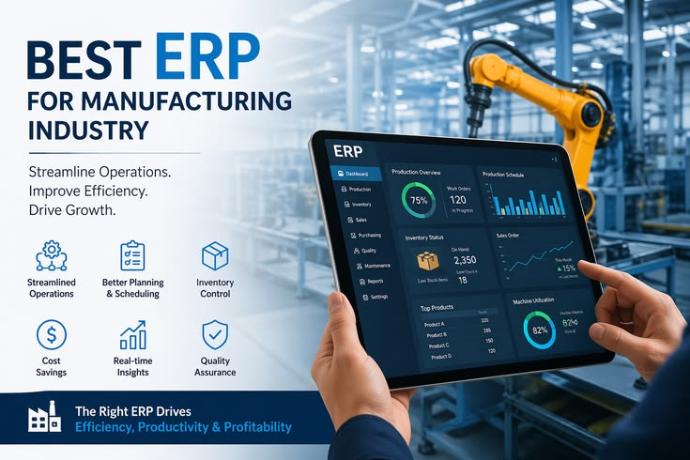
It gives complete visibility. Managers get a single dashboard showing inventory levels, job costs, quality control status, and warehouse locations. Problems and opportunities become much easier to spot before they become expensive.
It manages complexity. From Bill of Materials (essentially the "recipe" for building a product) to quality checkpoints and cost tracking, ERP handles the industry-specific details that keep a manufacturing business profitable.
Generic ERP vs. Manufacturing ERP
Not all ERP systems are built the same way, and this distinction matters more than people expect.
A generic ERP is a one-size-fits-all system. It can technically be adapted for almost any business, but manufacturers usually end up paying for heavy customization just to make it work for their needs.
A Manufacturing ERP, on the other hand, is purpose-built for the industry. It comes ready with features like production scheduling, shop floor control, and warehouse management already built in — meaning it fits right out of the box, with far less time and money spent on customization.
Who Is Manufacturing ERP For?
A common misconception is that ERP is only for large corporations. In reality, it's built for businesses of every size.
- Small businesses often go with cloud-based ERP because of lower upfront costs, faster setup, and the ability to access the system from anywhere.
- Mid-market companies need built-in analytics and industry best practices to stay productive and competitive as they scale.
- Large enterprises require robust systems with advanced capabilities like AI and machine learning to automate and transform operations across multiple sites or countries.
How Is It Implemented? (Deployment Options)
There are three main ways to deploy an ERP system, and the right choice depends on your company's size, budget, and IT resources.
Cloud deployment means the software is hosted by the vendor and accessed over the internet. The vendor manages updates, security, and maintenance, which reduces the burden on your internal IT team.
On-premise deployment means the software runs on your own company's servers. This gives you more direct control, but your IT team is responsible for all maintenance, security, and updates.
Hybrid deployment blends the two, with some applications running in the cloud and others kept on-premise — often used by companies transitioning between systems or with specific compliance needs.
In Summary
Manufacturing ERP is a specialized software solution that brings together all the core processes of a manufacturing business into one connected system. It replaces scattered tools and spreadsheets with a single source of truth, improving efficiency, visibility, and decision-making — and ultimately helping the business grow and compete more effectively.